


Sunday Devotional
After coming to know Jesus at the age of 33, I couldn't imagine doing anything without including my Savior. Every Sunday, we will start the week at the West TN Box Score by sharing a short devotional, and my prayer is that each person who reads it will receive a blessing.
8-30-26

Please Try Again Preseason workouts have started back up, and they are not always easy. In one of our recent workouts, there was a common theme: players started strong, began to fade, and eventually stumbled their way to the finish. This is true in so many areas of life. There are so many places where we start strong, only to find ourselves fading somewhere in the middle. We stumble. We get tired. Sometimes we simply run out of gas. And these struggles open the door for us to talk about what it means to finish the race well. When I got home, I began thinking about what happens when you lose the race. You tried, you gave what you had, but in the end, you just couldn't get it done. Those thoughts took me back to my first few years coaching at Bradford High School. I learned a lot during those years. Getting to work with Tim Allen was such a blessing, and I am honored to be working with him again. He is one of the best in the business. I also learned a great deal from Merideth Richardson Jacobs about what hard work really looks like. But the biggest lesson I learned at Bradford didn't come from a player or a coach. It came from a Twist A Pepper cap after a particularly tough loss. I sat there with my Dr. Pepper in my hand and turned off the bottle top. I did not get the winner, just another loss with the words “Please Try Again.” At first, I thought, Well, go figure. Ain't this just par for the course? But as I sat there staring blankly at those three words, something changed. It struck me that perhaps this is really all a man can do. Try again. I have failed so many times—as a coach, as a husband, as a father, and most of all, as a follower of Jesus Christ. I have stumbled in races I thought I was prepared to finish. I have started well and faded badly. I have stood at the end of things with nothing left but the knowledge that I didn't quite make it. But if I have one redeeming quality, it is this: I will try again. I think about the biblical characters we hold so dear. David was deeply flawed. Peter was deeply flawed. Neither man could claim a perfect record. But they were willing to get back up. They were willing to turn the cap again, and to take another step toward home. If you are out there struggling this morning, remember this: Jesus loves you. His grace is sufficient. Your failures are not final. Please try again. Keep twisting that old cap. Keep running the race. And sooner or later, by the grace of God, you may find the winner waiting for you. That simple lesson has served me well for the last twenty-five years—in my home, in my work, in coaching, and most importantly, in my walk with Christ. So if today finds you somewhere in the middle of the race, tired and wondering if you have enough left to finish, don't quit. Take another step. And then another. Please try again. -Eric Hampton
8-23-26

Lovest Thou Me? A few weeks ago, I went down a familiar rabbit hole studying Genesis and that great rhetorical question God asks all of us: “Where art thou?” We followed those thoughts the next week with another question that every human being must answer, whether they want to or not: “Who do you say that I am?” If your answer is, “The Christ, the Son of the living God,” then there is a third question you must answer. There are those who worship multiple gods and would gladly add Jesus to their list. There are even records of demons who recognize Jesus as the Christ, yet they are still doomed. So there is one more question beyond the intellectual belief that Jesus was, in fact, who He said He was. In the book of John, after the resurrection, we find Jesus with His disciples. He turns to Simon, son of Jonas, and asks him a question that seems almost painfully simple: “Lovest thou me?” There it is—the big question. And in some strange way, it takes us all the way back to the beginning. “And thou shalt love the LORD thy God with all thine heart, and with all thy soul, and with all thy might.” You can figure out where you are. You can recognize Jesus for who He is. You can believe the right things and even say the right things. But without love, you are still missing it. Lovest thou me? Three times Jesus asks Peter that question. And three times Peter answers, in one form or another, “Thou knowest that I love thee.” In my old red-letter Bible, the words of Jesus that follow are simple enough to fit in the palm of your hand: “Feed my sheep.” Believing is not merely a thought we keep tucked away in our heads. The Greek word for believe carries with it the idea of trust that changes the way we live. No amount of works can save us, but as James reminds us, “Faith without works is dead.” The true answer to the question “Lovest thou me?” will not ultimately be found in our thoughts or our sentiments. It will be found in what we do. The answer to the greatest question is not simply something we say with our lips on Sunday morning. It is something we spend our lives answering. “Feed my sheep.” God Bless. -Eric Hampton
8-16-26

Who Do You Say That I Am? Last week I looked at a question that has followed me around for years: “Where art thou?” This week I want to look at one that every man must eventually answer. In the book of Matthew, chapter 16, verse 15, Jesus asks His disciples a question that, in one form or another, has been hanging over humanity ever since: “Who do you say that I am?” It is a remarkable question. For more than 2,000 years, people have wrestled with it. In His own time, some thought Jesus was a prophet. Others thought He was Elijah, or John the Baptist returned. The guesses were many, but Peter gave the answer: “Thou art the Christ, the Son of the living God.” It is almost strange to consider that, all these years later, people are still trying to explain Jesus away. Some religions call Him a prophet. Some call Him a teacher. Others describe Him as a great moral leader or a radical disrupter of His time. We have become very inventive in finding titles for Him, as though the right word might somehow make the question easier. But Jesus quietly keeps asking: “Who do you say that I am?” There is something wonderfully unsettling about that question. It does not ask what your neighbor thinks, what your preacher thinks, what your parents taught you, or what the world has decided. It asks what you believe. After Peter's answer, Jesus tells him, “Blessed art thou, Simon Barjona: for flesh and blood hath not revealed it unto thee, but my Father which is in heaven.” The Spirit is still revealing His person to us today. C.S. Lewis famously pointed out that Jesus does not really leave us the comfortable option of simply calling Him a good teacher or a good moral man. His claims force us toward a decision. If He was not who He said He was, then we are left with the uncomfortable alternatives Lewis described: liar, lunatic, or Lord. There is no particularly cozy middle ground. And perhaps that is why the question has endured. Jesus is not merely asking us to admire Him. He is asking us to recognize Him. Dear friend, we all have to face the question, “Where art thou?” And then we must do something with the question, “Who do you say that I am?” If your answer is, “Thou art the Christ,” then there is a third question waiting for you—one we will talk about next week. Until then, I hope you have a blessed week. —Eric Hampton
8-9-26

Where art Thou? In the very well-known story of Adam and Eve, they find themselves naked and attempting to hide from God. They hear the voice of the Lord God walking in the garden, and then comes the question at the end of verse 9 in Genesis 3: “Where art thou?” What a well-struck blow. This is perhaps the most rhetorical of all questions, because the good Lord knew exactly where they were. He was not asking for His own benefit, but for theirs. It is a question that every person who has ever drawn breath will have to answer. It is the question He whispers to each one of us: “Where art thou?” In hindsight, it is the most blessed question I have ever heard. How can a man know where he needs to be until he first knows where he is? Oh, when the realization of my sin hit. Oh, to know that I was lost and undone. Oh, to understand that by my own sin I had separated myself from the God who loved me. “Where art thou?” Naked and in sin, it was that question that started me home. Since the day I surrendered, this has remained a haunting question. And I am thankful that it haunts me, because it helps keep me in line. After He saved my soul and brought me peace, the fear was gone, but the question remained. “Where art thou?” When I am prone to wander, it calls me home. When I face temptation, it points me toward the way of escape. When I face doubt, it reminds me that He is with me. When I fall away, it reaches down and picks me up. Yes, that blessed, haunting question. The same question asked of Adam. The same question I heard when I was lost in sin. The same question I still hear today. Where art thou? Dear friend, each one of us will have to give an answer. So listen. He is calling. Where art thou? -Eric Hampton
8-2-26

The Blood It has been revival week at my home church, and there is hardly a better way to prepare my heart before another school year begins. Revival gives us a chance to refocus—to make our way once again to the foot of the cross, to surrender what we have been carrying, and, by God's grace, leave it there. One of my favorite parts of revival is that we always seem to dig a little deeper into the old Heavenly Highway Hymnal. Before long, we'll come across a song I haven't heard in years. Those worn hymnals are filled with more than familiar melodies. They are rich with Scripture, grounded in sound theology, and seasoned by generations of believers who sang their faith before they ever spoke it. One evening this week we sang The Blood That Stained the Old Rugged Cross. If you have ever knelt at Calvary in repentance and faith, you know why those words still stir the heart. They remind us that our hope is not found in our goodness, our resolve, or our religion, but in the precious blood of Jesus Christ, shed once for all upon the cross. Rather than trying to improve upon that timeless message with my own stumbling words, I'll simply encourage you to take a few moments today to read the lyrics to that old hymn or better yet, sing it. Let its message settle over your heart once again. The cross has never lost its power, the blood has never lost its cleansing, and the Savior who shed it is still calling weary souls to Himself today. "On the cross of Calvary our blessed Savior died Gave His life to save the world from loss In His pain and agony for every sin too high Shed the blood that stained the old rugged cross Was His blood, His precious blood that stained the old rugged cross Was His love that paid the awful cost O soul, so far astray, come and plunge today In the blood that stained the old rugged cross To the cross, the rugged cross, they nailed His precious hands And in death He fully paid the cost There is pardon in His blood for every one that stands For the blood that stained the old rugged cross Was His blood, His precious blood that stained the old rugged cross Was His love that paid the awful cost O soul, so far astray, come and plunge today In the blood that stained the old rugged cross" God Bless -Eric Hampton
7-26-26

Life For years, my daughter Julie practiced basketball in Greenfield, which meant a pretty long drive for us. Over those years, we found all kinds of ways to pass the time, and one of our favorites was playing an electronic version of the old board game Life. I would tell Julie my choices, and she would spin and roll for me (since I was driving and all). The other day I came across an old post on my timeline where I told the story of one of those games. My very first spin sent me to college. By my third turn, I was married with a child. We had barely gotten started when Julie laughed and said, "You're a granddaddy!" Then, on the very next turn, just like that, the game was over. I couldn't help but think about how much that old board game had in common with real life. Here I am—school behind me, one daughter married, another in college, a house full of little ones again, and retirement drawing steadily closer with each passing season. The reality is this: before long, it will all be over. I have always heard people say, "If you live to be 100, it's still not very long." The older I get, the truer those words become. Scripture is full of reminders that our lives are but a vapor. I won't quote them all here; I'll let you look them up. Lol. I thank the Lord for this gift of life He has given me. I thank Him even more for the heavenly inheritance He has given me through His Son, Jesus Christ. During my brief stay here, my prayer is that I will always bring Him glory and honor the family name of Christ well. Help me, dear Lord, to remember the words of Brother Lawrence: "Our sanctification does not depend as much on changing our activities as it does on doing them for God rather than for ourselves." We're all just passing through this place on our way Home. God bless, and have a wonderful Sunday. -Eric Hampton
7-19-26

Moth and Rust It has been one busy summer. Between a new baby, weddings, birthday parties, and all the celebrations in between, our house has looked as though some strange hybrid of a toy store and a decorating warehouse exploded inside it. With the uncomfortable realization that, ready or not, school is about to begin again, I've spent the weekend trying to bring a little order back to the chaos. One of those jobs was putting away the wedding decorations. As I climbed into the attic looking for empty storage bins, I came across the one pictured. Apparently, it's Jordan's athletic award bin. Inside were trophies, All-District awards from three different sports, team MVP plaques, medals from meets, and a handful of photographs. These aren't ancient relics from decades ago. Jordan hasn't even been out of high school for three years—she's still in college. Yet a remarkable athletic career already sits quietly in a plastic tote, collecting dust beneath the rafters in an attic. That little bin reminded me of a verse I've shared at every athletic awards banquet I've ever coached. It has always struck home because, as I've gotten older, I honestly have no idea where my own high school awards are. "Lay not up for yourselves treasures upon earth, where moth and rust doth corrupt, and where thieves break through and steal: But lay up for yourselves treasures in heaven, where neither moth nor rust doth corrupt, and where thieves do not break through nor steal: For where your treasure is, there will your heart be also." — Matthew 6:19–21 Moth and rust. Those three words carry more weight the older I get. We spend so much of our lives reaching into empty treasure chests—athletic achievements, careers, money, recognition, or the applause of others. Then time quietly passes, and one day those treasures are tucked away in an attic, boxed up beneath a thin layer of dust. We discover they were never the treasure after all. Your soul is eternal. Those things are not. There are priceless lessons to be learned through sports, but those lessons are the treasure, not the accolades. The greater question is this: Do you know Him? Do you know Jesus this morning? I'm thankful for the Cross today. I belong to Him not because I've obeyed perfectly, not because I've managed to give up enough things, and not simply because I've been sorry for my sins. I am justified because of the death of Christ—because of what Jesus accomplished on the Cross. It is finished. He bore the sins of the world that day—for every one of us. As I was reading this morning, I came across a note written in the margin of my Bible: "The salvation of God does not stand on human logic; it stands on the sacrificial death of Jesus." Amen. My prayer today is that I will cling a little tighter to what is eternal and loosen my grip on everything that is only moth and rust. God bless. -Eric Hampton
7-12-26

Batter Up Leaving church last Sunday with our new baby in tow, while trying to convince a six-year-old to clean up the mess we had left in the pew, I somehow managed to leave my Bible behind. So this week I've been reading from my old study Bible—the one my wife gave me shortly after I gave my life to Jesus. I always enjoy opening it. The margins are crowded with notes, underlined verses, and reminders from seasons of growth that I had nearly forgotten. One note, scribbled in the margin years ago, simply read, "God always bats last!" It's a simple thought for a sports fan like me, but it carries a profound truth. Time and again throughout Scripture, just when it looks as though the game is over, God steps to the plate. The Red Sea parts. The giant falls. The stone is rolled away. What appears to be the final inning is often only the moment before God writes the ending. The same has been true in my own life. I can look back on so many situations I didn't understand, seasons that seemed unbearably bleak, and moments when all hope appeared lost. Then, almost without warning, the Lord moved. What looked like defeat became victory. What felt like an ending became the beginning of something better. And we don't just have our experiences—we have His promises. "For I know the plans I have for you..." "Every knee shall bow and every tongue confess that Jesus Christ is Lord." "He will wipe away every tear from their eyes, and death shall be no more; neither shall there be mourning, nor crying, nor pain anymore, for the former things have passed away." Just think about it: God always bats last. What a comfort for the believer. I'm a stubborn soul, cut from that stiff-necked stock Scripture talks about, but I've lived long enough to see the outcome too many times to doubt it now. My God bats last. As my dad enters the final days of his earthly journey, I find myself returning often to the wisdom he quietly carried. Years ago, two men much smarter than I am were debating the book of Revelation and finally asked my dad what he thought. He smiled and said he could summarize the whole book in just two words: "God wins." Amen. So whatever burden you're carrying today, lay it at the foot of the cross. Give it to Jesus. There are two truths worth holding onto with both hands: God always bats last. And God wins. -Eric Hampton
7-5-26

A Something In 1 Chronicles 19, when David sent messengers to comfort Hanun after the death of his father, Hanun was convinced by his friends that David's men had come as spies and were out to destroy him. That suspicion led to a great war and nearly wiped his people from the earth. Think about that for a moment. Well-meaning friends completely fabricated a story—or, at the very least, made assumptions that simply were not true. I cannot count how many times someone has believed or assumed something about me that wasn't true. Even more troubling is how often I have assumed things about others based on "reliable information." Just recently, I discovered I had been wrong in one such case. Sometimes, if we're honest, we even want those rumors to be true. We have itching ears and an appetite for the latest bit of tea. I once came across a note from an old preacher that read: "You will always find 'a something' if it is 'a something' you are seeking, but you will also always find what is good and beautiful if you are in search of that." The words hit like a good slap to the face. Hanun and his friends were seeking a something, and it cost them dearly. What do our somethings cost us? What are we looking for in others—the good, or "a something"? The human heart is remarkably skilled at finding whatever it has already decided to seek. Lord, teach me to look for what is good. Teach me to seek what is beautiful in others before I go searching for a something. -Eric Hampton
6-28-26

In His Presence Life has been coming at me very fast lately—a new job, a daughter getting married, another daughter in college, two small children, and a brand-new baby. One of the things weighing heaviest on my mind has been my dad's failing health. It causes you to pause and recognize just how quickly it all passes. As Jimmy Buffett once said, “Summers and winters, scattered like splinters, and 20 more years slipped away.” It has even been difficult to find that quiet time to spend with the Lord. One of my favorite Christian writers was a preacher from Memphis named Herb Hodges. I have probably dropped a few "Herbisms" throughout these devotionals as I've put them to paper. This morning I came across another quote of his that has been gently tapping at my heart, reminding me of what is truly important on this very brief journey. "It is this way for every person who is away from God and not active in His service. He is busy, but what is he really achieving? He is feeding and clothing himself, raising a family, perhaps building a home, but to what purpose? His is a treadmill existence. He lives like a man trapped in a revolving door, going round and round, but getting nowhere. Every minute away from God is a wasted minute, a minute you must account for when you stand before Him." —Herb Hodges Oh, how I wish I could remain here in this quiet time with the Lord, because I know that when I get up and face the day, I will get caught up in the world and tuck my Lord away in my back pocket. "O wretched man that I am." So I pray: Lord, guide my steps and remind me to do all things as though I am doing them for You. May I live out my walk each day, carrying Your presence into the ordinary moments of life, for those moments are the very stuff our days are made of. God bless. -Eric Hampton
6-21-26

Father's Day On this Father's Day, my thoughts are a little jumbled. Becoming a new father again at my age has left me with a touch of baby brain. As I sit here thinking about my own dad, my mind keeps returning to one verse: "Train up a child in the way he should go: and when he is old, he will not depart from it." —Proverbs 22:6 As a kid, I was what we used to call a "drug baby"—drug to church every time the doors were open. It wasn't optional in our house; it was simply what we did. As I grew older, I rebelled, like so many of us do. I thought I knew better. But much like the prodigal son, I eventually found my way home. This morning, I am grateful for the home I was raised in—a home where hearing God's Word was never treated as a suggestion. I'm thankful for a dad who didn't just tell me about the Scriptures but lived them in front of me every day. I'm thankful for parents who prayed for me, remained patient with me, and loved me even when I made it difficult. Now that I have five children of my own, and have come to know the fierce, protective love a father carries for his children, I understand a little more why Scripture so often calls God our Heavenly Father. Why Jesus taught us to pray, "Our Father." The love of a good father is steadfast, forgiving, and always hoping for the child's return. It is only a faint reflection of the perfect love our Heavenly Father has shown us. So today, I am thankful for my earthly father. And even more, I am thankful for my Heavenly Father—longsuffering, patient, and always ready to welcome this wayward son home. To all the dads out there, Happy Father's Day. I hope you have a blessed day -Eric Hampton
6-14-26

Wondrous Mystery I have been blessed with the opportunity to share my testimony many times over the years. There was a season in my seeking when I thought faith would come through a convinced mind. I wanted to understand it all. I wanted answers to every question and explanations for every mystery. When I couldn't find them, I grew frustrated and, at times, even a little jaded. But then that day came—that wondrous mystery—when the Holy Spirit convicted me of my sins. Even now, I struggle to fully explain what happened. Yet I can tell you this: I never received the convinced mind I was searching for. No, I was given something far better. I received a changed heart. This morning, during my study, I came across a quote from A.W. Tozer and thought I would leave it here today: “If I can understand God, then I cannot worship God. I will never get on my knees and say, ‘Holy, Holy, Holy’ to that which I can figure out. That which I can explain will never overawe me, never fill me with astonishment, wonder, or adoration. But in the presence of that most ancient mystery, that unspeakable majesty, which the philosophers have called a mysterium tremendum, and which we who are God's children call, ‘Our Father who art in Heaven,’ I will bow in humble worship.” — A.W. Tozer As I read those words, I was reminded that faith is not a puzzle to be solved but a Person to be known. The morning light may reveal the shape of the trees, but it never exhausts the depth of the forest. So it is with God. Each step with Him brings greater clarity, yet His majesty still stretches beyond the horizon of our understanding. I am thankful for the change that was wrought in me, though I do not completely understand it. There is much I will never know on this side of eternity, but praise be to Jesus—the One who does. Amen. -Eric Hampton
6-7-26

I Shall Not Be Moved I was sitting in church before Sunday School started this morning, gathering my thoughts, when I glanced beside me and noticed my little girl hard at work on the artwork attached to this devotional. I wasn't sure what she was creating, and, truthfully, I didn't give it much thought at the time. At the end of church, I saw her notebook still resting in the pew. Curious, I picked it up and found a drawing of a tree beside a stream, with the lyrics to I Shall Not Be Moved carefully written across the page. There was something fitting about that image. A child, quietly drawing a tree by the water while the church gathered around her, reminding me of a truth that has steadied saints for generations. Considering I've been operating on very little sleep lately, I thought today's devotional might simply be these old hymn lyrics. Sometimes the old songs say it better than we ever could. I Shall Not Be Moved Glory Hallelujah, I shall not be moved, Anchored in Jehovah, I shall not be moved; Just like a tree that's planted by the water, I shall not be moved. In His love abiding, I shall not be moved; And in Him confiding, I shall not be moved; Just like a tree that's planted by the water, I shall not be moved. Though all hell assail me, I shall not be moved; Jesus will not fail me, I shall not be moved; Just like a tree that's planted by the water, I shall not be moved. Though the tempest rages, I shall not be moved; On the Rock of Ages, I shall not be moved; Just like a tree that's planted by the water, I shall not be moved. I shall not be, I shall not be moved; I shall not be, I shall not be moved; Just like a tree that's planted by the water, I shall not be moved. The world seems determined to keep us unsettled—pulled by worry, hurried by schedules, and shaken by circumstances. Yet the image remains: a tree planted by the water, drawing life from a source deeper than the weather around it. Perhaps that's why this old hymn still resonates. It reminds us that stability is not found in calm conditions but in deep roots. And sometimes, on a sleepy Sunday morning, the Lord chooses to deliver that reminder through the pencil of a little girl. -Eric Hampton
5-31-26

Job This morning I was just kind of jumping around in the Good Book—flipping pages, looking for something, though I couldn’t have said exactly what I was looking for. I just knew I was looking. The pages finally settled at the opening of Job, and there I came across a note I had written in the heading: “We are nearly always longing for an easy religion—easy to understand and easy to follow; a religion with no mystery, no unsolvable problems, no snags. A religion that would allow us to escape our miserable human condition; a religion in which contact with God spares us all strife, all uncertainty, all suffering, and all doubt; in short, a religion without the Cross.” I didn’t have a source for that quote written down, but it really hit me this morning. I’ve been studying the crucifixion in the Gospel of Luke, and I’m so thankful for Jesus and for what He did for all of us on that rugged cross. But if I’m honest with myself, the old flesh I’m wrapped in—even after all Christ has done for me—still hesitates when it comes time to take up my own cross and follow Him. Maybe that’s part of what the Lord was showing me in Job this morning. Faith has never been promised as a road without hills or shadows. Scripture never paints discipleship as polished and painless. The cross stands at the center of our faith—reminding us that glory often comes through surrender and sacrifice. Dear Jesus, show me how to follow You more faithfully. Teach me to carry what You ask me to carry, and to trust You with every step. God bless. -Eric Hampton
5-24-26

Remember Me There was once an old preacher named Herb Hodges. I first met him not long after I was saved, and his preaching, emails, and books had a deep influence on my growth in the Lord. I was up early yesterday morning and came across a quote from Brother Herb that stopped me in my tracks: “Daily quiet time with the Lord is not to get your needs met; it is to look away from all else and unto Jesus.” This morning I was back in Luke with that thought still lingering in my mind, and there at the cross I ran smack into two thieves—and my heart broke a little. The scene felt painfully familiar. I realized that more often than not, I am the first thief. “If thou be Christ, save thyself and us.” The first thief was consumed with the urgent and immediate. He was thinking only of the here and now, only of his own need, his own relief, his own rescue. And mercy—when I read those words, they landed heavy. Because if I’m honest, that sounds a whole lot like most of my prayers. Too often it’s about me. My burdens. My plans. My wants. My timeline. Then the second thief speaks. “We receive the due reward of our deeds.” He understood something essential: he was a sinner in need of mercy. That’s where salvation begins—with an honest heart before a holy God. But he didn’t stop there. He lifted his eyes beyond the nails, beyond the pain, beyond the dying light of that afternoon and said: “Lord, remember me when thou comest into thy kingdom.” There it was. His thoughts were not fixed on escaping the moment. They were fixed on the Kingdom. That challenged me this morning. It reminded me where prayer ought to begin—not with “Lord, what can You do for me?” but with “Lord, what would You have me do for Your Kingdom?” I almost sound like JFK there for a second—LOL, but it’s true all the same. My prayer this morning is simple: Lord, help me get past myself—past my wants, my preferences, my little kingdoms—and seek first Yours. I’m thankful for the Holy Spirit and thankful for God’s Word. It sure has a way of stepping on your toes. But I’ve learned over the years that what bruises my toes is usually doing something good for my heart. -Eric Hampton
5-17-26

Service Sometimes you find the Lord speaking the same truth from every direction. Over the past week, I have come across Scripture, found myself in conversations, and even opened devotionals that all seemed to circle the same theme: service. It is as though Heaven keeps tapping gently on the shoulder of the heart until we finally stop long enough to listen. This morning, while preparing for Sunday School, I was reading in the Gospel of Luke and came to Luke 22:27, where Jesus asks, “For whether is greater, he that sitteth at meat, or he that serveth? Is not he that sitteth at meat? But I am among you as he that serveth.” In that upper room, beneath the flicker of oil lamps and the shadow of the coming cross, Christ once again turned the world’s understanding of greatness upside down. The King of Glory chose the towel over the throne. With that thought lingering in my mind, I came across this story in a devotional: “One Sunday morning, a man on his way to church was unexpectedly delayed. He arrived late and said to the usher at the door, ‘Is the service over?’ The usher replied, ‘Oh, no.’ The man started in and was nearly bowled over by the sudden opening of the doors and the rush of people leaving the building. He said to the usher, ‘I thought you said the service wasn’t over!’ The usher soberly replied, ‘Sir, it isn’t. Only the time of worship is over. Now, the service begins!’ Is the sermon done at the end of the service? No, it has only been preached; now it must be lived.” There is such simple truth in that little story. Worship was never meant to end at the church doors. The hymns, the preaching, the prayers — they are meant to follow us into the quiet errands of Monday morning, into conversations with strangers, into moments where kindness costs us something. Faith becomes most visible when it rolls up its sleeves. May the Lord continue to guide me into a life of service, and may He give me the strength and willingness to obey. Amen. -Eric Hampton
5-10-26

Moments I like to think I’ve been acutely aware of moments ever since I was a kid. I used to write the phrase, “You remember moments, not days,” with a Sharpie on the basketballs I practiced with in the backyard—a small reminder to myself of what hard work might someday become. Forty-nine years has taught me that the saying was true, but incomplete. Yes, it is the moments you remember, but you rarely know when they are arriving. Most often, they slip in quietly, dressed like ordinary afternoons. Sometimes they come and go before we even realize what they were, and only the passage of time reveals them. I had one of those moments with my son not long ago. He had an early morning practice, and seeing as how he is five years old, I wasn’t really keen on attending, but the coach in me wouldn’t let him skip. He had a good little practice, and afterward, as we walked back to the car in the cool morning air, we had one of those simple Dad-to-Son talks you have in those moments. I told him I was proud of him. I gave him the serious dad look and said, “I’m not proud because you did good. I’m proud because you listened to your coach and went hard. If you do that, the good will take care of itself.” Then he smiled, cocked his head to the side, and said, “I made it my masterpiece.” I was taken aback. I had never really had that conversation with him, but I had said those words many times to a group of eight-year-old girls in the gym. Apparently, while I thought he was busy flying a toy lizard around the bleachers, somewhere in the middle of that imaginary flight, he had been listening. It’s a phrase I say often while coaching—borrowed from John Wooden—and there stood this five-year-old little boy applying it in his own way. I tell that long story just to get to the moment. The moment for me was realizing that little ears are always listening, and little eyes are always watching, even when we think they are not. It was a sharp reminder of how careful I need to be in my walk, how intentional I need to be with my words, and how guarded I need to be about what he is exposed to. “Train up a child in the way he should go, and when he is old, he will not depart from it.” Our children are going to learn far more than we realize. The question is: who are we allowing to pour into them? Better yet, what are we allowing to pour into them? We have to guard their hearts and minds carefully in a world that is always trying to shape both. Yes, I was proud that a five-year-old was applying a lesson I didn’t even know he had learned. But if I’m honest, I was also terrified by the thought of everything else out there he may learn. What a responsibility. Today, on this Mother’s Day, I am deeply thankful for a godly wife who trains our children in the ways of the Lord with patience, tenderness, and faithfulness. I pray that Jesus guards the paths of all my children and grants us wisdom as we try to raise them well. Amen. —Eric Hampton
5-3-26

Eternity Reading in the book of John this morning—John 12:27–28 in particular—“Now is my soul troubled; and what shall I say? Father, save me from this hour: but for this cause came I unto this hour. Father, glorify thy name.” It is so easy to be caught in the narrow corridor of the here and now, where everything feels like it is all there is. And surely, if we live only in the here and now, the soul will be troubled. When those troubles come, how quickly we turn, as I wrote in an earlier devotional—questioning, even accusing—“God, don’t you care?” The words rise almost instinctively; the here and now calls for an answer. But the answer is not found in the present moment; it's not found in our current circumstances. It is found in the Cross—this hour—where Christ bore all the sins of the world, and where, in that moment that he paid the price for us, the Father’s name was glorified. When we look there, we encounter a love that does not flicker or fade, but consumes and steadies. In that hour, what Jesus accomplished reframes everything; we see through the lens of the cross, through the lens of eternity. “I am he that liveth, and was dead; and, behold, I am alive for evermore, Amen.” And if you know Him, you are gathered into that same promise. “Let not your heart be troubled,” for He has overcome death and the grave. So as we walk through these here-and-now moments—these small, pressing struggles of each day—let us learn to see them through the Cross, through this hour. And in doing so, may our lives, even in their quiet trials, echo that same prayer: Father, glorify thy name. -Eric Hampton
4-26-26

Attentive The picture for today’s devotional is of my favorite dog ever, Si. He was part of our family for many years, and whenever I had a piece of cheese in hand, he became the most attentive creature you could imagine—eyes fixed, body still, every sense quietly leaning forward in expectation. I came across a quote from Martin Luther that sums this photo up beautifully: “If only I could pray the way my dog looks at the morsel of food on my plate. All of his thoughts and actions are concentrated on it. At the moment, he is a mix of reverence and desire. Through his reverence and fear of me, he will not jump on the table, but because of his desire for the food, he never gives up on longing to possess it” -Martin Luther I’m reminded of the importance of a quiet place, as my own prayer life is so often distracted. As I sit down attempting to share my thoughts, there is much more stirring beneath the surface. I’m still working my way through the Gospel of Luke, and recently I read the account of Jesus driving the money changers out of the temple again. I had been there before—Palm Sunday reflections lingering like echoes—and I reckon, if I had the courage to ask, there are tables in my own life that need overturning, things that ought to be driven out of this temple. If only I would heed the old hymn: Have Thine Own Way, Lord. Yet for all that could be unpacked there, it was a few verses later that caught and held me. We find the chief priest and scribes looking to destroy Jesus, but they ran into a snag as we read Luke 19:48. “And could not find what they might do; for all the people were very attentive to hear him.” Oh my! Reread that one verse, sit with it a moment. Imagine what our homes, our churches, our communities might look like if we were truly attentive to hear him. What a heart pricker, as I have to ask myself: Am I attentive to his word? Am I attentive to his Spirit? Am I attentive to his call? “If only I could pray the way my dog looks at the morsel of food on my plate.” Pray for me today—that I may become more attentive, that I may hang on every word, that I may serve my Lord and Savior more faithfully. I hope you all have a blessed week. -Eric Hampton
4-19-26

Family A few weeks ago, I found myself thumbing through old photo albums with my little boy. He likes to study his daddy as a child, as if searching for some early clue to the man before him. In the turning of those pages, I came across a photograph—circa 1981—of my family on vacation. It has always been one of my favorites. Looking back on those moments with my son beside me, I’m struck by the quiet abundance of it all—the steady, unassuming grace that marked my upbringing. A quick glance through that album reveals a life stitched together with simple, enduring joys: family Barbecues where laughter lingered in the humid air, trips to state parks where the world seemed wide and green, Christmas mornings lit by the glow of The A-Team and The Dukes of Hazzard, a well-worn BMX bike that might as well have been a chariot. There were road trips following one sister to beauty reviews, and longer journeys trailing another as she sang her way across the country—one photograph even catching my mom beside Randy Travis, as my Sister opened a concert for him. I grew up a coach’s kid, and if you love sports, there is no finer inheritance. Gyms and ballfields became a second home, their rhythms as familiar as breath. I had both sets of grandparents, and they were of that World War II generation—married in Corinth, and if you had grandparents who married in Corinth, you know, they stayed married. As mine did. Their lives formed a kind of living covenant, a steady witness to what it means to endure for all their family to see. And through it all, I was taken to church every time the doors were open. I didn’t always appreciate it. I can still remember the tension of a Super Bowl about to begin, only to hear, “Get in the car, boy.” At the time, it felt like a small injustice. But now I see it differently. My family made sure I heard the Word of God. And though I strayed as far as I could wander, that truth—“train up a child”—proved itself faithful. I found my way home. All praise to Jesus. But make no mistake, He used my family as His instrument. I share this because I believe it is one of the very things the enemy seeks most to unravel—that picture of a family. Husbands and wives who remain through hardship because they made a vow before a Holy God. Parents who raise their children with intention and prayer. Siblings who know, without question, they are not alone. A dinner table where heads bow, and hands fold, and someone, somewhere, is always praying for you. Satan does not like this! I’ve seen enough in twenty-five years of teaching to know how fragile—and how powerful—these things are. So this morning, I give thanks. I am grateful for the family that raised me, for Godly grandparents whose lives still echo. Thankful, too, that I was one of those “drug babies”—drug to church every Sunday, even during the Super Bowl. I’m thankful for my wife, who carried the spiritual weight of our home when I didn't have the wherewithal to do so. Thankful for children I now lead through those same church doors, praying over them, trusting that what is planted will one day hold. “They will not depart from it” And I find myself returning to an old song, one that seems to gather all these memories into its refrain; it's become an anthem when my siblings and I gather with our parents. “We sang songs, songs from childhood, Hymns of faith that made us strong, Songs that Mother Edna taught us, Hear the angels sing along. May the circle be unbroken, By and by, Lord, by and by, There’s a better home awaiting, In the sky, Lord, in the sky.” -Eric Hampton
4-12-26

Amazing Grace I reckon for the entirety of my life that little church in Reagan has sung Amazing Grace every single Sunday morning. Even when I was away, I knew it was still being sung, steady as the sunrise. There was a quiet blessing in that thought. I have always believed John Newton had such a powerful testimony, and that this song was born out of it. I think it endures because of the truth in it. If you have ever come face to face with your sins and then had them forgiven by Jesus, it will find you where you are and settle deep within you. I have sung this song more than any other I know, and every now and then, the words will take hold of me and reduce me to a tearful mess when I think of the unmerited grace and mercy bestowed upon me. “Amazing Grace, how sweet the sound, that saved a wretch like me! I once was lost, but now I’m found, was blind but now I see.” Oh, how the Devil had me blind for so many years. I was a reprobate, if you will, with no thought for my soul—going about blindly, until that Amazing Grace came. “’Twas grace that taught my heart to fear, and grace my fears relieved.” That one line makes a Baptist want to shout. When I think about wandering in my sin, and that day in my bedroom in Medina, Tennessee, when my sin was made known to me—when my heart was shown the great fixed gulf between the Lord and me—it was that Amazing Grace that let me see I was on the wrong side, that I was lost. It was the grace of God that caused my heart to fear, and then… that same grace, upon surrender to Jesus, relieved those very fears. “How precious did that grace appear the hour I first believed.” Precious may not do it justice. “Through many dangers, toils, and snares I have already come; ’tis grace that’s brought me safe thus far, and grace will lead me home.” These short lines still reach out and grab hold of me. I was just talking with a friend about all the things I don’t understand—how I even survived them. And although I may not understand, I do know how: it was grace. By the grace of God, I’m typing these words this morning, and that same grace will lead me home. “When we’ve been there ten thousand years, bright shining as the sun, we’ve no less days to sing God’s praise than when we first begun.” Through grace, one day, that circle will be unbroken, and we will spend eternity together. If the Good Lord is willing and the creek don’t rise, as they say, I will be at that little church this morning, and we will sing this song. And at the end, we will sing a stanza where the words “Praise God” are repeated over and over. When I think about that Amazing Grace—the grace that drew me, that opened my eyes, that saved a wretch like me—what else could a man say but: “Praise God, Praise God, Praise God, Praise God, Praise God, Praise God, Praise God, Praise God.” Hope you all have a great week, and God bless. -Eric Hampton
4-5-26

I AM I spent the day reflecting—turning over, again and again, the question of who Jesus is and what His resurrection truly means. My thoughts have bounced like bingo balls in a wire cage, each one clattering into the next, refusing to settle. This has been stirring in me since Good Friday, so bear with me—I do believe there is a point here somewhere, even if the path to it winds a bit. I’m not quite sure where to begin, but I suppose Charlton Heston is as good a place as any. I caught a few minutes of The Ten Commandments on the old tele Saturday night. I’ve never quite understood why that movie always seems to find its way onto the screen the night before Easter, but it has been that way for as long as I can remember. It got me thinking about Moses: “God said to Moses, ‘I AM WHO I AM.’” He also said, “Say this to the people of Israel: ‘I AM has sent me to you.’” —Exodus 3:14 There’s a weight to that moment that presses in on me. I think about Moses—how many turns his life had already taken to arrive at that burning bush, and how many more lay ahead. It settles in, quietly but firmly, that our lives, too, will bend in ways we never expect (like welcoming another baby at 49), yet through it all, God is present—steady, unchanging, the great I AM in the midst of our motion. Then my mind turns to Jesus. My favorite Gospel account has always been the Gospel of John. “In the beginning was the Word, and the Word was with God, and the Word was God.” And then, just a few verses later: “And the Word was made flesh, and dwelt among us… full of grace and truth.” John says it plainly, yet its depth continues to unfold. When Jesus speaks those “I AM” statements—from John 8 through John 11—He is not speaking casually. Each declaration echoes the voice from the burning bush. The Jews of that time knew exactly what He was saying: a claim not just to authority, but to identity. It brings to mind the words of C. S. Lewis in Mere Christianity: Jesus is either a liar, a lunatic, or the Son of the living God—the Savior of the world. There is no middle ground that holds for long. I think, too, of Mary at the empty tomb, mistaking Him for the gardener until He speaks her name: “Jesus saith unto her, Mary.” And in that single word, recognition dawns. “Rabboni,” she replies—Master. My mind drifts back to John 10, where Jesus says, “I AM the good shepherd… and the sheep hear his voice: and he calleth his own sheep by name.” There is something deeply personal in that—something that cuts through the noise of the world. He calls, and we know Him. Not as an idea, not as a distant figure, but as One who speaks our name into the quiet places of the heart. Since Good Friday, I’ve also been YouTubing S. M. Lockridge—especially his sermon, “It’s Friday, but Sunday’s Coming.” And once you start down the S.M. rabbit hole, it’s hard not to watch a few more of his messages. One of my favorites is entitled, “That’s My King.” (go give it a watch if you have a minute) His words rise and roll like thunder, yet land with a simple, unavoidable question. And so, after taking the long way around, I find myself here: Every person, at some point, must answer the question Jesus asked His disciples: “Who do you say that I am?” He is the great I AM. He is the Christ, the Son of the living God. He is the Word wrapped in flesh. And maybe the final question—borrowed from Lockridge—lingers longest of all: Do you know Him? Oh, do you know Him today? I am so thankful He calls me by name. Do you know Him? —Eric Hampton
3-29-26

Mothers Intuition Today is Palm Sunday, and there are countless directions a devotional could take as we step into Holy Week. But my mind has been elsewhere. My niece was married yesterday, and my own daughter will soon be walking that same aisle. Lately, my thoughts have been filled with weddings—the quiet weight of them, the sense that something sacred is beginning even as something else ends. So this morning, instead of my usual studies for this season, I found myself at a wedding in Cana. Someone once told me, “The more you grip Scripture, the more Scripture grips you,” and I’ve found that to be true. Certain passages, revisited in different seasons of life, seem to deepen, familiar, yet somehow richer. I have been blessed with a wonderful mother and two wonderful grandmothers. And for over twenty years now, I’ve had a front-row seat to watching my wife, Rachel, in action. I’ve come to believe that mothers simply know some things—call it a mother’s intuition, or perhaps something quieter and holier. And I think some of the most sound theology in the entire New Testament comes not from a sermon, but from a mother at a wedding. There, at Cana, in the hush before the miracle, when the need was quietly noticed and gently carried to her Son, she turns to the servants and says, “Do whatever He tells you.” That’s it. No flourish. No exposition. Just obedience—plain and steady as a heartbeat. Throughout the Old Testament, the heroes we admire were deeply flawed men, their one redeeming quality often being obedience. “Follow me,” Christ says again and again in the New Testament, and here, at the beginning of His public ministry, His mother distills it into words so clear they almost seem too simple to carry such weight. DO WHATEVER HE TELLS YOU. It is the kind of wisdom only a mother can give—unadorned, practical, and somehow eternal. And I find myself praying, especially in this season of beginnings and letting go, that I might learn to live inside those words a little more faithfully. That is when the moment comes—quiet or momentous—I might simply do whatever He tells me. -Eric Hampton
3-22-26

Chariots of Fire Still studying in the Gospel of Luke, this morning my reading turned to the cost of being a disciple. One of my favorite movies has always been the 1981 classic Chariots of Fire, which tells the story of Eric Liddell. As a kid, I mostly loved the music—the dialogue felt long, and the meaning sailed over my head like a high pass I wasn’t ready to catch. But as with many things in life, age has a way of slowing the moment down so you can finally see what was there all along. What once sounded like speeches begins to sound like conviction. One of the film's great points is Liddell’s refusal to run on Sundays, a decision that revealed what mattered most. Years ago, I felt a strong conviction about that same subject while traveling to AAU games on Sundays, slipping into early church services along the way just to check the box before heading back to the gym. The Lord made it clear to me that I was abandoning vows I had made, bowing to an idol while pretending to put Him first. Under that convicting spirit, we made a decision in our home long ago that Sundays would be set aside. But the Lord, in His patience, always seems to tell the rest of the story. What began as sacrifice slowly became routine, and routine—if you are not careful—can become pride. The commitment that once cost something started to feel like something I could point to, rather than something I could lay down. Satan has a way of bending even good things until they face the wrong direction. Some years later, a sort of sequel to that story came in the film On Wings of Eagles, where we learn more about Liddell’s life as a missionary. In a prison camp, near the end of his life, his words were simple: “It’s complete surrender.” Not Sunday surrender. Not a convenient surrender. Complete surrender. I have always loved the old hymn I Surrender All, and I often think of it when sharing my testimony. Salvation, for me, came at the end of myself, at the point where holding on was harder than letting go. In Luke, Jesus seems to gather that same truth into one sharp line. “So likewise, whosoever he be of you that forsaketh not all that he hath, he cannot be my disciple.” — Luke 14:33 Too often, I find myself trying to take back control of things I once surrendered, picking up what I had already laid at His feet. Pride is a tool the devil uses well, polishing it until it looks like faith. This morning, my prayer is simple. Lord, let me take no pride in surrender. Give me the courage to be obedient to what You ask of me. Let my work, my words, and my days be pleasing in Your sight. Remind me that it is not only Sunday that You want, but Monday through Saturday as well. As Dietrich Bonhoeffer wrote in The Cost of Discipleship, “True grace is free, but not cheap.” — Eric Hampton
3-15-26

Plans With baseball season starting up, it is that time of year to pull the old movies off the shelf, and much like Hoosiers, Field of Dreams has always been one of my favorites. It is the rare kind of movie that ages along with you. I loved it as a kid, I loved it as a young man, and I may love it most now, when the years have a way of sharpening the meaning of things that once seemed simple. The older I get, the more I find I cannot watch it without seeing the quiet fingerprints of Scripture all through it. Ray hears the voice and follows it, though it makes no sense — much like Abraham hearing the command to sacrifice his son. He keeps working when he looks foolish to everyone around him — like Noah building an ark under a clear sky. Even when Shoeless Joe appears, Ray still does not fully understand what is being asked of him — the way Peter could not yet see the purpose of the cross. Obedience comes first. Understanding comes later. Sometimes much later. Then comes the scene that stays with me the most, the one that seems to speak louder the older I get. The one where I most relate to our character. Ray has done everything he was asked to do, and still nothing makes sense. The field is built, the money is gone, the future looks uncertain, and frustration finally breaks through. He says, “I’ve done everything you asked me, and not once have I asked what’s in it for me.” Shoeless Joe ask, “What are saying Ray?” almost in the same breath, the question slips out anyway — “What’s in it for me?” “I think you should stay Ray” When I watch that moment, I think of how often I find myself in the same place, trying to follow the Lord while wondering where the road is leading. And then I think of the promise from Jeremiah: “For I know the plans I have for you.” Not plans we always understand. Not plans we always see clearly. But plans that are perfect all the same. Let that sink in! We couldn’t see it, but he was working all along! In the end, the whole journey was not about the field, or the games, or even the ghosts. It was about a son and his father, standing in the fading light, having one more catch. Every time I see that scene, I am reminded that one day I will get to do the same — not on a ball field in Iowa, but in a place far better, where all the questions are answered and all the broken things are made whole. Thank you, Lord, for speaking even when I do not understand. Thank you for leading even when the path looks strange to my eyes. Give me the courage to be obedient when it makes no sense, because time and again You have shown that Your plans are better than anything I could have imagined. -Eric Hampton
3-8-26

Ripe I was pondering the frailty of life when I had one of those moments where something you read years ago suddenly rises back into your mind. It arrived like an old photograph pulled from a drawer—familiar, a little worn, but still speaking. I did some digging around and found just what I was looking for. It was part of an old sermon by Charles Spurgeon. A great reminder that we are all, in one way or another, ripe. Then, as the good Lord often does, He reemphasized the subject while I have been slowly working my way through the book of Luke. I was in Chapter 12 and came across the parable about greed. I am not trying to play mental gymnastics with the passage—it is clearly about greed—but one particular verse carried my thoughts back again to the frailty of life. “But God said unto him, Thou fool, this night thy soul shall be required of thee; then whose shall those things be, which thou hast provided?” The entire reading was a good “toe-stepper,” as we say, forcing me to consider where exactly I have been laying up my treasure. As for the frailty of life I have been thinking on, Spurgeon tells it better than I ever could when he said: “We are all living, and what for? For the Grave. I have sometimes sat me down, and had a reverie like this: I have thought - man, what is he? He grows, he grows, till he comes to his prime, and when he is 45, if God spare him, he has perhaps gained the prime of his life. What does he do then? He continues where he is a little while, and then he goes down the hill; and if he keeps on living, what is for? To Die. But there are many chances to one, as the world has it, that he will not live to be seventy. He dies very early. Do not we all live to die? But none shall die till they are ripe. Death never reaps his corn green; he never cuts his corn till its ripe. The wicked die; but they are always ripe for Hell when they die: The righteous die; but they are always ripe for Heaven when they die. That poor theif there, who had not believed in Jesus perhaps an hour before he died, he was as ripe as a seventy years saint. The saint is always ready for glory whene”ver death, the reaper comes; and the wicked are always ripe for Hell whenever The reaper comes for them. 0, that great reaper! He sweeps through the earth, and mows his hundreds and thousands down. It is all still; death make no noise about his movements, and he treads with velvet footfall over the earth - that ceaseless mower, none can resist him. He is irresistible, and he mows, and mows, and cuts them down. Sometimes he stops and wets his scythe in blood, and then mows down with war; then he takes his whetstone of cholera, and mows down more than ever. Still he cries, More! More! More! Ceaseless that work keeps on. Wondrous mower! Wondrous reaper! O, when thou comest to reap me, I cannot resist thee; for I must fall like others: when thou comest I shall have nothing to say to thee. Like a blade of corn, I must stand motionless, and thou must cut me down! But, O! May I be prepared for thy scythe! May the Lord stand by me and comfort me, and cheer me; may I find that death is a angel of life - that death is the portal to Heaven; that it is the outward porch of the great temple of eternity; that it is the vestibule of glory” -Charles Spurgeon Scripture reminds us just as plainly: “Lay not up for yourselves treasures upon earth, where moth and rust doth corrupt, and where thieves break through and steal:” Matthew 6:19 It is a sobering thought—that all of us, like grain in a field, are slowly ripening under the sun of passing days. We rise in the morning, go about our work, laugh with friends, worry about bills, cheer at ballgames, and plan for tomorrow. Yet somewhere in the quiet background of life, the reaper walks softly through the rows. I am thankful for the reminder today that we are all ripe. Most of all, I am thankful for my Savior, Jesus. Through Him (not Blue Oyster Cult), I don’t fear the reaper. Do you know Him today? Time is short, and my prayer echoes the simple plea of the old hymn: don’t put off salvation too long. -Eric Hampton
3-1-26

The Winter of Our Discontent Today began with sickness moving quietly through our house. From the stomach bug to the Southern crud, we seemed to have it all. My little boy had it the worst, so I missed church this morning to take him to the doctor. He has a touch of pneumonia. In one of my earlier devotions, I wrote about the seasons of life, and this week has been a difficult one for me. With the sickness, the stress, and the steady churn of things on my mind, it was a line from William Shakespeare that set this devotional into motion. Over the years, I’ve learned that most people you meet have a unique talent or quirk you would never guess. One of mine is that I love Shakespeare. I had some wonderful teachers in high school, and, being a romantic (lol), Romeo and Juliet first set me on that path. I grew to love much of his work and, for a season of life, actually read Shakespeare for fun. That word—season—had my mind turning this morning as my little buddy and I drove to the doctor; the hum of the tires down the interstate welcomed a wandering mind. “Now is the winter of our discontent, made glorious summer by this sun of York.” That line has echoed through the centuries. John Steinbeck borrowed it for his book The Winter of Our Discontent and also penned the piercing truth, “To be alive at all is to have scars.” Life does sometimes slap you around. Lately, I’ve felt as though I’ve been walking through my own winter of discontent. The phrase has long been linked to hard times, and perhaps that is why it endures—because every man can relate. As the old preachers say, there is a broken heart on every pew. Winter itself often feels like a kind of dying, the trees stripped bare, the landscape hushed and colorless. Another small fact about me: outside of Shakespeare, I enjoy reading Christian writers from the 1600s. I am always amazed that the truth found in Scripture remains relevant to the human condition in every era. And though this may have sounded heavy so far, there is a bright ending. Richard Sibbes once wrote, “Life in the winter is hid in the root.” What are you rooted in today? Jesus said, “I am the true vine.” I cannot imagine life without my Savior. When the winter of discontent settles in, I still have peace. I am hidden in the Root, and I know the sun is coming because I know the Son. God, don’t you care? Don’t look to your circumstances to find the answer to that question, LOOK TO THE CROSS. The Cross is where every question about God’s love finds its answer. So even in winter—through sickness, stress, and trying times—life remains in the Root, in the true Vine, and the burden feels rolled away. Thank You, Jesus, for what You did on that old cross. God bless. -Eric Hampton
2-22-26

Miracle A few things lined up today in the writing of this devotional. In my Sunday School lesson, we passed by a line in the book of Luke: “The labourers are few.” Then, when I got home from church, I saw that the U.S. Hockey Team had won gold. That was it. God’s providence works in peculiar ways, but I am pretty sure this is for someone. You may ask, what does hockey have to do with anything? That is a valid question, and I will attempt to explain. During the 1980 Winter Olympics, I was about three and a half years old. I do not have many memories from that age, but I do have a few. When we were kids, we would often go to Barbara and Larry’s house—my aunt and uncle’s—and the adults would play cards while we children did whatever children in 1980 did to occupy long evenings. But one of my clearest memories is of a black-and-white television and that game being on. I remember how excited the adults were. Maybe it is just the replays over the years and my mind playing tricks on me, but I will tell you this: I remember Al Michaels’ call—“Do you believe in miracles?” We are not hockey folks, and I have only watched a handful of games in my life. But that one made an impression. Growing up, the stories of that game made it seem as though a true miracle had taken place. Then, around the year 2000, Walt Disney Pictures released the movie Miracle. It instantly became one of my all-time favorite sports movies. I loved the story. I was just beginning my coaching career at that time, and it resonated with me in a deep way—the discipline, the belief, the idea of ordinary men being called to something extraordinary. To this day, one of my favorite pieces of sports memorabilia is an autographed jersey signed by the 1980 U.S. Olympic Hockey Team. One of those names is Jim Craig, the goalie on that team. A few years ago, he shared a thought in an interview that serves as the genesis of this week’s devotional. When asked about the “Miracle on Ice,” Craig gave an answer I was not ready for. He spoke of how much it agitated him that it was called a miracle. At one point, he offered this thought: “It was no miracle, we just worked harder than they did.” They being the Russian team. His words struck a chord: “We just worked harder.” As soon as he said it, my mind went straight to Proverbs 6:6–8: “Go to the ant, thou sluggard; consider her ways, and be wise.” From there, I was reminded, “For we are labourers together with God.” And this morning in Luke 10: “The harvest truly is great, but the labourers are few: pray ye therefore the Lord of the harvest, that he would send forth labourers into his harvest.” We must be careful with this passage before we rush off to work; do not skip over the word “pray.” The command to labor is framed by dependence. Still, work is scriptural. When I consider that we are called to labor, old Jim Craig’s words begin to haunt me. I would say it is safe to admit that many of the things we complain about—the state of things, per se—have come to be because the devil works harder than we do. Is the devil outworking me today? I do not really want to answer that question. Almost every basketball coach keeps a copy of “The Easy and The Hard”—you can Google it if you have never read it. Life is hard. Broad (easy) is the way that leads to destruction; narrow (hard) is the way that leads to life. The path of least resistance is paved smooth, but it rarely leads anywhere worth going. Jim Craig and that 1980 hockey team have been an inspiration to me in recent years—not because of a miracle, but because I am reminded how much hard work matters. I am reminded that I need to be working for something bigger than myself. The Christian life is not lived in highlight reels or dramatic calls from the broadcast booth; it is lived in daily obedience, in unseen faithfulness, in the quiet labor of the field. I pray I will be more obedient and a better worker in that field. And perhaps, by God’s grace, when the harvest comes, it will not be because of a miracle—but because we were willing to work. -Eric Hampton
2-15-26

Just as I am. I was listening to Gospel music on YouTube the other day—using YouTube as my own little radio station has become something of a habit, almost a liturgy of its own. I came across a version of “Just As I Am” by Willie Nelson, and it carried me backward nearly twenty-five years, to a night thick with rain and memory. There was a Willie Nelson concert in Skull Bone, Tennessee—an outdoor place, a natural amphitheater cupped in the hills like a rough-hewn cathedral. A storm rolled through that night with the kind of authority only Southern weather can muster. Lightning stitched the sky; thunder spoke in long, rolling syllables. Most folks scattered for home, but the show went on. By the time Willie stepped onto the stage, the crowd had thinned to a faithful remnant. Those of us who remained pressed beneath the small pavilion near the stage, shoulder to shoulder, damp and defiant. It was really an intimate environment at this point. I had come prepared for the weather—tall rubber boots and, tucked inside them, several small bottles of Old Whiskey River Bourbon. At this particular point in my life, I was a bit more like the lyrics to a Merle Haggard song than Willie, “Despite all my Sunday learning, with the bad I kept on turning”. Needless to say, I was about out of my head by the time Willie decided to close the show with a full set of Gospel music. The o’l boy standing beside me was from Mississippi, he had made the drive north with friends to see the Red-Headed Stranger. We’d talked casually between songs, the way strangers do when music makes them kin for a night. And then, somewhere in the middle of those hymns, he broke. I mean truly broke—shoulders shaking, tears falling freely, a grown man weeping without apology. That Gospel set hit him hard, and he had gone to repenting right there on the spot. I did not. However, it did make an impression. In those days, I frequented places I had no business being, and more than a few of them would close the night with a Gospel song—as if even sin wished to end on a borrowed note of grace. Not much fazed me back then. But something about the name of Jesus always made me uneasy. It was like a tuning fork struck somewhere deep in my chest. There is power in that name. As the years passed and my soul grew restless, I told myself I wanted a convinced mind. I thought faith would arrive as an argument won, a case neatly made, doubts dismissed like witnesses with nothing left to say. But when the moment finally came—when the Holy Spirit dealt with me, when Jesus spoke softly but unmistakably to my heart—I did not receive a convinced mind - I got something so much better…I got a changed heart instead!!! “Just as I am without one plea, but that Thy blood was shed for me.” I did not come to Him polished or prepared. I came as I was—muddy boots and all. And He did not wait for me to clean myself up. He drew me. He changed me. I am thankful for Jesus. Thankful for the drawing power of the Holy Spirit. Thankful that salvation is not awarded to the well-argued but given to the surrendered. As it was written of another seeking soul: “He wanted to see God with eyes of the flesh and to confirm the vision by reason; but God is seen by the inner eye of the heart, and the vision is confirmed by faith.” — The Sinner of St. Ambrose -Eric Hampton
2-8-26
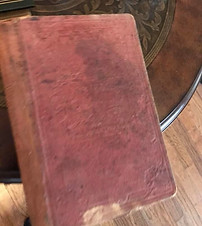
He Set Me Free My nephew recently came across some old belongings of my grandfather, and among them was the book pictured here. According to the inscription inside the cover, it was gifted to my great-great-great-grandfather, Hugh Lawson Hampton, in May of 1889. The book was written by a man named John B. Gough, who, as a bit of digging revealed, was a leading voice in the Temperance Movement. Unsurprisingly, temperance is its chief subject. Curiosity got the better of me, and I began to read. Early on, a line stopped me cold: “It is not pleasant to recall these experiences. But history has nothing to do with the pleasant or the unpleasant. It has only to tell the truth.” Nearly sixteen years of sobriety can make it tempting to forget one’s history, to tuck it neatly away like an old coat that no longer fits. But another line from the book cut closer to the bone: “He curses his misery, while he hugs the chains that bind him.” It reminded me how necessary it is to share my own struggles. For so many years, I clung to the very things that were on the verge of destroying me. In the story “The Sinner of St. Ambrose,” the main character, wrestling with Christianity, declares, “If Christ conquers, then Rome must die, and I love Rome!” That line haunted me for years because I recognized myself in it. I loved drinking. Even as it was killing me, I didn’t want to let it go. I grasped tighter and tighter. I wanted salvation and freedom from addiction, but I simply could not release what I loved. Christ calls us to die to self, to take up our cross daily and follow Him. Jesus paid the price for our sins at Calvary—He did it. There is nothing we can add, nothing we can earn, only something we can accept. And I can tell you from personal experience: you won’t miss Rome. When I finally came to the foot of the cross and let go of all I had been clinging to, my hands were at last free to receive that free gift of grace—that amazing grace that saved a wretch like me. I am free today, and the life Jesus gives is richer, finer, and eternal. If you are struggling with something today, I pray you take it to Jesus. He will set you free. God bless. -Eric Hampton
2-1-26

The Dash I was digging around in my study Bible the other day—the way one sometimes does, not searching for anything in particular, but open to being found—and I came across a poem called The Dash. Brother Derrick had shared it during a sermon a few years back. I don’t have specific notes from that day; it may have been about sanctification or something of the sort. Still, the poem stayed with me, lingering the way certain Scripture passages or half-remembered hymns do. If you know me, you also know I love studying family history. For a season, it was my absolute favorite hobby, and I still dabble in it from time to time. I’ve traced both my wife’s family and mine to what I like to call illegitimate royalty (which sounds about right, lol). I can go back at least seven generations on every branch without much doubt, backed by DNA, public records, family stories, and notes scribbled long ago in old Bibles. Over the years, studying all these people who came before me, I can’t help but ponder the dash in each of their lives. I see the history—the wars fought (Revolutionary, 1812, Civil, World War I, World War II, Korea, Vietnam). I see the ocean crossings (my wife has ancestors who came over on the Mayflower). I see loss—the loss of children, the loss of fortune, with the Great Depression hitting one branch especially hard. Then I start thinking about my own life and try to view it through the lens of Scripture, and something becomes clear. Man, that dash is hard. It ain’t easy—and it’s short, too. I used to know an old preacher who would always say, “There’s a broken heart on every pew.” Still, life itself is also a blessing. Lately, I’ve been asking a lot of the Good Lord in my prayers, really wanting Him to do some things for me, because this dash is hard work. Then I was reading my Bible and came across 1 Corinthians: “For we are laborers together with God.” Some versions say co-laborers. And, boy, I became ashamed of my prayers. All I could think about was the movie Where the Red Fern Grows, and that little boy who had to meet God halfway. God gave him the strength, but he still had to put in the work. So this morning I prayed for wisdom and strength, understanding that the work is up to me. The dash is work. I’ll always remember some of my grandmother’s last words: “Make sure those girls know what work is.” Both my grannies had a great dash. Below is a copy of the poem from my notes. I hope you enjoy it. God bless. I read of a man who stood to speak at the funeral of a friend. He referred to the dates on the tombstone from the beginning…to the end. He noted that first cam the date of birth and spoke the following date with tears, But he said what mattered most of all Was the dash between those years. For that dash represents all the time that they spent alive on earth. And now only those who loved them know what that little line is worth. For it matters not, how much we own - the cars…the house…the cash - What matters is how we live and love and how we spend our dash. So, think about this long and hard. are there things you’d like to change? For you never know how much time is left that can still be rearranged. If we could just slow down enough to consider what’s true and real, and always try to understand the way other people feel. And be less quick to anger and show appreciation more, and love the people in our lives like we’ve never loved before. If we treat each other with respect and more often with a smile, remembering this special dash might only last a little while. So, when your eulogy is being read with your life’s actions to rehash, would you be proud of the things they say about how you spent your dash?
1-25-26

Snow Day I woke up pretty early this morning, with a lot on my mind. If you have four kids ranging from engaged and nearly finished with college to pre-K, and a wife expecting again, you tend to carry a lot with you into the day. Prayer becomes a constant companion. You pray for your children—sometimes feeling almost selfish in how specific the prayers are—but you want them to know the Lord. You want them to have a real childhood. You want them, one day, to find Godly spouses and steady ground on which to build their lives. It’s a lot. Standing still, watching the coffee swirl in my mug in the quiet of the morning, a man can think a little. The white landscape outside my window pulls my mind immediately to Isaiah 1:18, and to that old hymn rooted in the verse—“Nothing but the Blood.” Snow has a way of doing that, of turning Scripture into something visible. But it’s another verse in Isaiah that has become a kind of snow-day tradition for me, one tied closely to a shared testimony that I have always related to. It’s the verse my family will gather around this morning, as we place our hope in the promise that “when two or more are gathered together in my name…” Isaiah 45:22 says, “Look unto me, and be ye saved, all the ends of the earth: for I am God, and there is none else.” That verse sits at the heart of a snow-day story from a Sunday morning many years ago—one whose story has stayed with me. This morning, I hope you’re all safe and warm. Days like this make me thankful for the small things, the quiet things. But most of all, I’m thankful for Jesus and what He did on the cross. I’ve shared this before on Facebook, but if you’ve never read Charles Spurgeon’s testimony in his own words, it’s well worth your time. Below is his story, born out of a snowed-in Sunday morning of his own. I hope you enjoy it. God bless. The Testimony of Charles Spurgeon in his own words: “I sometimes think I might have been in darkness and despair until now, had it not been for the goodness of God in sending a snowstorm one Sunday morning, while I was going to a certain place of worship. I turned down a side street and came to a little Primitive Methodist Church. In that chapel, there may have been a dozen or fifteen people. I had heard of the Primitive Methodists, how they sang so loudly that they made people’s heads ache, but that did not matter to me. I wanted to know how I might be saved.... The minister did not come that morning; he was snowed up, I suppose. At last, a very thin-looking man, a shoemaker, or tailor, or something of that sort, went up into the pulpit to preach. Now it is well that preachers be instructed, but this man was really stupid. He was obliged to stick to his text for the simple reason that he had little else to say. The text was—"LOOK UNTO ME, AND BE YE SAVED, ALL THE ENDS OF THE EARTH" (Isa. 45:22) He did not even pronounce the words rightly, but that did not matter. There was, I thought, a glimmer of hope for me in that text. The preacher began thus: "This is a very simple text indeed. It says, ‘Look.’ Now lookin’ don’t take a deal of pain. It ain't liftin’ your foot or your finger; it is just ‘Look.’ Well, a man needn’t go to College to learn to look. You may be the biggest fool, and yet you can look. A man needn’t be worth a thousand a year to look. Anyone can look; even a child can look. "But then the text says, ‘Look unto Me.’ Ay!" he said in broad Essex, "many on ye are lookin’ to yourselves, but it’s no use lookin’ there. You’ll never find any comfort in yourselves. Some say look to God the Father. No, look to Him by-and-by. Jesus Christ says, ‘Look unto Me.’ Some on ye say ‘We must wait for the Spirit’s workin.’ You have no business with that just now. Look to Christ. The text says, ‘Look unto Me.’ " Then the good man followed up his text in this way: "Look unto Me; I am sweatin’ great drops of blood. Look unto Me; I am hangin’ on the cross. Look unto Me, I am dead and buried. Look unto Me; I rise again. Look unto Me; I ascend to Heaven. Look unto Me; I am sitting at the Father’s right hand. O poor sinner, look unto Me! Look unto Me!" When he had... managed to spin out about ten minutes or so, he was at the end of his tether. Then he looked at me under the gallery, and I daresay with so few present, he knew me to be a stranger. Just fixing his eyes on me, as if he knew all my heart, he said, "Young man, you look very miserable." Well, I did, but I had not been accustomed to having remarks made from the pulpit on my personal appearance before. However, it was a good blow, struck right home. He continued, "And you will always be miserable—miserable in life and miserable in death—if you don’t obey my text; but if you obey now, this moment, you will be saved." Then lifting up his hands, he shouted, as only a Primitive Methodist could do, "Young man, look to Jesus Christ. Look! Look! Look! You have nothing to do but look and live!" I saw at once the way of salvation. I know not what else he said—I did not take much notice of it—I was so possessed with that one thought . . . . I had been waiting to do fifty things, but when I heard that word, "Look!" what a charming word it seemed to me. Oh! I looked until I could almost have looked my eyes away. There and then the cloud was gone, the darkness had rolled away, and that moment I saw the sun; and I could have risen that instant, and sung with the most enthusiastic of them, of the precious blood of Christ, and the simple faith which looks alone to Him. Oh, that somebody had told me this before, "Trust Christ, and you shall be saved." Yet it was, no doubt, all wisely ordered, and now I can say— "E’er since by faith I saw the stream, Thy flowing wounds supply, Redeeming love has been my theme, And shall be till I die. . ." That happy day when I found the Saviour, and learned to cling to His dear feet, was a day never to be forgotten by me…I listened to the Word of God, and that precious text led me to the cross of Christ. I can testify that the joy of that day was utterly indescribable. I could have leaped, I could have danced; there was no expression, however fanatical, which would have been out of keeping with the joy of that hour. Many days of Christian experience have passed since then, but there has never been one which has had the full exhilaration, the sparkling delight which that first day had. I thought I could have sprung from the seat in which I sat, and have called out with the wildest of those Methodist brethren . . . "I am forgiven! I am forgiven! A monument of grace! A sinner saved by blood!" My spirit saw its chains broken to pieces, I felt that I was an emancipated soul, an heir of heaven, a forgiven one, accepted in Jesus Christ, plucked out of the miry clay and out of the horrible pit, with my feet set upon a rock and my goings established . . . . Between half-past ten o’clock, when I entered that chapel, and half-past twelve o’clock, when I was back again at home, what a change had taken place in me! Simply by looking to Jesus, I had been delivered from despair, and I was brought into such a joyous state of mind that, when they saw me at home, they said to me, "Something wonderful has happened to you," and I was eager to tell them all about it. Oh! There was joy in the household that day, when all heard that the eldest son had found the Saviour and knew himself to be forgiven.
1-18-26

Behold the Man I do my best to visit the cross as often as possible, and my youngest daughter will sometimes sing the song, How Deep the Father's Love For Us at church on Sundays. There is a line, “Behold the man upon a cross.” I always glance at the statue of the crucifixion when she sings it. (In scripture, that line comes before the cross, “Behold the man” was in John 19:5 when Pontius Pilate presented a scourged and mocked Jesus, wearing a crown of thorns, to the crowd.) When I took a closer look, I thought, ah this statue has the sign, but the sign simply read INRI, and I had no idea what that meant. I’m not that smart. So I googled it, and came to find out it is the correct abbreviation for JESUS OF NAZARETH, KING OF THE JEWS. So I got to digging around a little more, and wouldn’t you know, there was more to this. Old Pilate wrote it in three different languages for all to see; he was making a political statement and sticking it to the Jews, but more importantly, it was correct. The Jews were God’s chosen people, and Jesus was the Messiah, to be rejected by men, wounded for our transgressions, by his stripes we are healed. The Jewish leaders asked Pilate to take it down, and he said, “What I have written, I have written.” Now, I’m no Bible scholar, but over the years of coaching, I have always had a pretty good feel for people. After rereading all four accounts, it seems to me that by the end, Pilate was greatly troubled by Jesus. We find him asking, “What is truth?” and then he left the room. For us, we know Jesus is the way, the truth, and the life. Pilate returns and asks, “Whence art thou?” Boy, I believe Pilate already knew the answer to that question; he just didn’t want to face it (just my thoughts). That is the question we all have to answer. Jesus asked the disciples 2,000 years ago, “Who do you say that I am?” He’s still asking each heart today! That question troubled Pilate; does it trouble you today? Behold the Man, “Look unto me and be ye saved all the ends of the earth.” What is truth? “I am the way, the truth, and the life.” Jesus of Nazareth, King of the Jews: “My Kingdom is not of this world!” And that last question, Jesus would not answer for him, you see, we have to confess ourselves, “Thou art the Christ, the Son of the Living God!” Dear friend, if your heart is troubled today like Pilate once was, don’t walk away, don’t wash your hands of it, don’t leave Jesus to the religious. Repent and receive the gift of eternal life through Jesus Christ! May you each have a blessed week!
1-11-26

These Hands It seems I have a love-hate relationship with the entity we know as Facebook over the years, and every time I almost delete it for good, I find something redeeming in it. One of these redeeming features is the memories that come up each day; it is worth keeping around just for the memories. We all have those people in our lives that we miss. I miss both my grandmothers dearly as they played such a role in who I am. It was five years ago in December that my Granny Hampton passed, but not before she got to meet Jacob. I treasure this picture of her hands. Just before this picture was taken, she was pointing one of those fingers at my two older daughters, telling them, if they do nothing else, learn what work is. I’ve shared some thoughts on this particular set of hands before that I thought were fitting for a devotional today. THESE HANDS.. These, these hands have hoed some tough rows and worked many fields. These hands wrote letters back and forth to a soldier during WWII, which eventually turned into a forever love. These hands have been folded in prayer for all her loved ones. These hands cooked the best food you have ever eaten, and you know you’ll never eat something that good again. These hands spanked my bottom when I did wrong. I tried to tell her she wasn’t my momma, but she just said, “I am your grandmomma,” and then those hands went to work on my rear. These hands know what work is. These hands know what love is. Oh, I’m so thankful that I got to experience These Hands firsthand. Remembering These Hands makes me so thankful for another set of hands. Jesus told Thomas, “Rich hither thy finger, and behold my hands.” The two nail-scarred hands of Jesus. Because of His hands and her love for him, I know she has entered into his kingdom. And one day, that glad reunion day, when the circle will be unbroken… Through his hands, my hands, will hold her hands again! Thanks be to Jesus! God bless, hope you each have a great week.
1-4-26

New Year I was kind of aimlessly flipping through my Bible, as I sometimes do on New Year’s—almost searching for something, but not really sure what—when I came across a highlighted passage. Romans 4:7-8, which reads, “Blessed are they whose iniquities are forgiven, and whose sins are covered. Blessed is the man to whom the Lord will not impute sin”—and beside it, a note directing me to Psalm 32:1. It seems Paul is, in essence, quoting David. The words seemed to jump off the page, and my heart felt suddenly light. I am not who I need to be, but I know what I once was, and my INIQUITIES have been forgiven!!!! Praise be to God! And Amazing Grace, how sweet the sound that saved a wretch like me. I am blessed—not because of anything I possess in this life, but because I am forgiven; because of the promise of what is to come through faith in Jesus Christ. What a reminder to begin the New Year: a reminder that I have a new life in Christ. And so, in closing, my good ol’ Facebook memories produced a quote that seemed to walk alongside my thoughts today. For our first devotional of 2026, we’ll close with these words from Charles Spurgeon: “Take this, dear friends, for a new year’s text, both ye who love the Lord, and ye who are only looking for the first time. Christian! In all your troubles through this year, look unto God and be saved. In all thy trials and afflictions, look unto Christ, and find deliverance. In all thine agony, poor soul, in all thy repentance for thy guilt, Look unto Christ, and find pardon. This year remember to put thine eyes heavenward, and thine heart heavenward, too,” —Charles Spurgeon. “Look unto me and be ye saved, all the ends of the earth: for I am God, and there is none else.”
12-29-25

I surrender all Over Christmas, my two youngest kids received a set of Bible cards—and if you didn’t already know, I am a cardboard enthusiast—so let me just say, they are fantastic. As we worked toward completing the set, one card quickly became my favorite: Andrew’s. I’ve always loved how Andrew seemed to live for one simple purpose—bringing people to Jesus. I recognized the passage the moment I saw it. John 6. It has always been one of my favorite sections in the entire New Testament. And while bringing people to Jesus, as Andrew did, is a noble and necessary thing, Andrew is not the true focus of the card. It is the boy who holds my attention. The boy—and his lunch. “There is a lad here, which hath five barley loaves, and two small fishes: but what are they among so many?” For years I wondered why a kid would be walking around with five loaves of bread. It seemed odd to me. Later, after talking with someone who had spent time across the pond in the Holy Lands, I learned those “barley loaves” were likely about the size of a Ritz cracker, and the two small fish more like sardines. Suddenly the picture came into focus. This boy hadn’t packed a bakery—he had packed a lunch. And if I’m being honest, one of my lifelong struggles has been food. I’ve gotten better, but I can still be selfish when it comes to what’s on my plate. I used to loathe sharing French fries. If you wanted some, why didn’t you order your own? I’ve asked that question more times than I care to admit. My wife and kids have also accused me—fairly—of being what you might call a “hangry” person. We often talk about Jesus feeding the multitude, and rightly so. But the real miracle in this passage might be something else entirely: convincing a boy to give up his lunch. If I were that boy, I would have hesitated. I would have calculated. I would have guarded what was mine. But once he surrendered it, the miracle followed. God is still in the miracle business, if we’re willing to be like that unnamed lad. I struggled for years because I refused to surrender. I loved this world. There’s a book from the 1950s called The Sinner of St. Ambrose. When I left Bradford, I took it from an old stack of library books, mostly as decoration. It sat on a shelf for years until one day—by God’s providence—I felt compelled to pick it up. The story centers on a Roman struggling with Rome’s turn toward Christianity. He was a good pagan. In conversation with St. Ambrose, he says, “If Christ conquers, then Rome must die, and I love Rome.” When I read that line, I saw myself. I knew that if Christ conquered, self must die—and I loved my Rome. I fought that truth for years. But one day, at the end of my rope—lost, exhausted, and out of answers—I found myself asking the same question so many in the New Testament asked: What must I do? And no, I'm not crazy, I heard that still small voice speak to my heart as clearly as I have ever heard anything: There is nothing you can do. I have already done it. That was the moment I surrendered everything. Rome died. I gave Him my lunch, so to speak. And the miracle He worked in my life—if you had known me before—was right up there with feeding the multitude. So if you’re struggling with something today, lay it down. Let Rome die. Give Him your lunch. And just like that boy we still read about 2,000 years later, you will never regret it. I hope you all have a blessed week. -Eric Hampton
12-22-25

Good King Wenceslas Ol' Good King Wenceslas — it’s a song I’ve always known, one that seemed to hum through every December of my childhood. Still, I can’t say I ever paid it much attention. It was, in my mind, one of those “give to the poor and you’ll be blessed” kind of carols: a simple moral wrapped in a catchy tune. Everyone knows you should help those in need, right? To tell the truth, I never really sang all the words. I just hummed through it, the way most of us mumble through Hark! The Herald Angels Sing after the first verse. But not long ago, I found myself playing "Good King Wenceslas" on YouTube — one of those videos that displays the lyrics as the music plays. And somewhere near the end, the last two verses rose up and found me. They struck a chord somewhere deep in this old man’s soul. Over twenty times in the New Testament, Jesus says, “Follow Me.” One instance familiar to most of us: “Take up thy cross and follow Me daily.” It’s that daily part that gets me. Take a moment to read the carol’s final verses: Through the rude wind’s wild lament And the bitter weather, Sire, the night is darker now, And the wind blows stronger; Fails my heart, I know not how, I can go no longer. “Mark my footsteps, my good page, Tread thou in them boldly; Thou shalt find the winter’s rage Freeze thy blood less coldly.” In his master’s steps he trod, Where the snow lay dinted; Heat was in the very sod Which the saint had printed. Therefore, Christian men, be sure, Wealth or rank possessing, Ye who now will bless the poor Shall yourselves find blessing. Now, looking back over the years, I see it clearly: whenever I followed Jesus' lead, the winter’s rage froze my blood less coldly. When I stepped in His prints — not my own — even the hardest seasons softened. As Christmas approaches once again, that is my simple prayer: May I follow Him. May I stay in my Master’s footsteps. God bless, my friends.
12-15-25

As a little child This is always a hard week for me. The 21st arrives each year carrying more than a date should be asked to bear. It brings a rush of emotions, and this year—my wife expecting again—the memory of losing Isaiah feels closer, more present, like a hand on my shoulder that I did not know where it came from, but somehow understand. When it first happened, the love and prayers were a true kindness. In the weeks that followed, what stayed with us just as deeply were the stories—quiet, painful testimonies from others who had walked the same road. They did not fix anything, but they did something better: they let us know we were not alone. Isaiah, “God’s Helper,” is now home, waiting on us. Here in the present, life continues in its loud and ordinary mercy. Our living room is still full of kids. Toys underfoot. Laughter in the air. I’ve always enjoyed the Oak Ridge Boys, especially Thank God for Kids. There’s a line that has always landed softly but firmly with me: “Did you ever stop to think or wonder why, the nearest thing to heaven is a child.” Jesus once said, “Verily I say unto you, Whosoever shall not receive the Kingdom of God as a little child, he shall not enter therein.” – Mark 10:15 You could argue this was an object lesson in humility (I’ve read a few Andrew Murray books, lol), but as with most of Jesus’ teaching, it endures because it is simply true. Like almost everyone I know, I carry things around with me—stresses, frustrations, bitterness, anger, selfishness—all bundled up in that shiny package we call pride. It is far from the fruit I should be producing. Yet somehow, when little Jacob comes around the corner and says, “I love you, Daddy,” or when little Josie climbs up beside me and curls into my side on the couch, all of that weight loosens and falls away. I’m not carrying it anymore. In loving them, I’m reminded—sometimes suddenly, sometimes quietly—that I have a heavenly Father who loves me like this. It makes me want to cry out, “Abba.” Christ used children as His example, and I’ve often wondered if it was because the unconditional love of a child may be the closest thing we have to understanding His love for us. “While we were yet sinners,” He came. I am thankful for a Savior who came and died for my sins, and thankful for the blessing of children. They have a way of keeping everything in its proper perspective, without ever trying to. The day we lost Isaiah, I had one of those random Bible openings—an obscure passage that met me where I was and carried peace I could not manufacture on my own: “The righteous perisheth, and no man lay it to heart: and merciful men are taken away, none considering that the righteous is taken away from the evil to come.” – Isaiah 57:1 Much as King David lamented, He cannot come to me, but I can go to him one day. And today, I am thankful for my kids. I am jamming out to the Oak Ridge Boys. I am praising my Savior. And I am living with the steady, certain hope that one day, I will see Isaiah again.
12-8-25

Few and Evil Pharaoh asked Jacob, “How old are you, bud?” Jacob tells the years of his sojourning were 130—“few and evil,” he said, “have been the days of my sojourning.” I’ve found myself lingering over that exchange more than once through the years. I could give you pages of commentary and the echoes of every scholar who has tried to untangle Jacob’s meaning. But I keep returning to a few simple truths I can’t escape—and neither can you. We are strangers passing through this world. Jacob uses the word sojourning—pilgrimage—twice. Earth is no man’s home; our time on this earth is a brief stay, like travelers who pause for a moment before continuing to the place that is truly home. “Few and evil.” Anyone past forty probably knows the weight of the few. My own years feel like a Jimmy Buffett song: “Summers and winters, scattered like splinters, and twenty more years slipped away.” Our time here is short, and evil—that’s the more challenging part. But an honest look at my own life leaves me face to face with the truth Scripture names so plainly: “The heart is deceitful above all things and desperately sick.” My old nature is not noble; it is needy. Jacob’s words may be bleak, but they ring true. Yet here, in this tension between brevity and brokenness, Christ steps in. Jesus is the only answer. “Wretched man that I am, who will deliver me from this body of sin? Thanks be to God through Jesus Christ our Lord.” That’s it. Jesus. My hope and my stay. Nothing I can do—Christ has already done the work. As Paul said, thanks be to God for sending His Son—no other name. These thoughts have been sitting with me lately—the good and the evil, braided together in every life. But the good Lord always provides a way through. Have a blessed day.
12-1-25

Christmas Nativity My favorite of all our Christmas decorations is the nativity scene pictured beside this entry. After I set it up, I gathered the littles around and told the Christmas story as best I could. I showed them the angel, the star, the wise men, the shepherds, Joseph and Mary, and—most of all—the baby Jesus. I even mentioned that, according to some very smart people I’ve heard over the years, the true setting was likely a cave rather than the tidy wooden stable we arrange each December. When I finished, my sweet little Josie Claire looked up and said, “Tell me again, Daddy.” And at those words, my heart leapt straight to Heavenly Highway Hymns, No. 42—Tell the Sweet Story Again, with its line, “Jesus has died, lost sinners to save.” As we enter this season, Union Hill is once again preparing its live Nativity, and it is always a blessing. They begin with John the Baptist and carry the story all the way to the empty tomb. Every year it amazes me how the simple reenactment settles deeper into the soul, as if the familiar becomes newly tender in the cool night air. So if you’ve wandered your way to this entry and read this far, consider this an invitation: come and see. Come watch the sweet story unfold before your eyes. This Saturday, December 6, and Sunday, December 7, from 6:00 to 8:00 p.m., drive through—free of charge—at Union Hill Missionary Baptist Church, 105 Union Hill Church Rd, Reagan, TN, 38368. May the name of Jesus be lifted up. Hope everyone had a wonderful Thanksgiving, and God bless!
11-24-25

Cats In The Cradle Funny, the things that get you thinking. I was rocking out to Harry Chapin’s version of “Cat’s in the Cradle” with Josie one morning. I liked that song when I was a kid; then, when I was a teenager, UGLY KID JOE released their version, and I rocked that one all over again. Later, when the older girls were young, we returned to Harry Chapin’s rendition—the standard, I suppose. Well, Josie really liked it, too, and was singing right along. I thought it was pretty cool because I’d always loved singing it with her sisters. But something happened while I was singing it with Josie. I started, as the Grinch says, “leaking.” Let’s be honest—it was more than a leak. I was man-crying. All those years, the song had never quite moved me that way. I understood it perfectly when I was young; I “got” the story. It wasn’t lost on me. But now that I’m older—now that my two girls in college drift through the house like travelers passing on their way elsewhere—I no longer just understand the song. I have lived it. And that living, that experience, is what brings such a response. Why? Because there is a world of difference between understanding something and experiencing it. For years, I understood the Gospel message of Jesus. I could tell you the story, recite the truths. But it did not change me until I experienced Jesus. And I fear there may be many who “understand” the Gospel but have never truly experienced it. I pray that if you haven’t, you will today. It will change your life. Have a blessed week.
11-17-25

A New Season “How can a game have such an effect on a man’s soul? The way I see it, how can it not?” This quote from the movie 7 Days in Utopia has always resonated with me. This old gym, pictured, freshly refinished, is one of my favorite places in the world. Within the next 48 hours, most West Tennessee high schools will kick off their 2025-2026 basketball seasons. I have coached in over 1,300 games. I played basketball through college and baseball through high school. My kids have played sports I didn't even know were sports. I have seen many seasons. All of these sports seasons remind me that life has many seasons…Some have been good, some have been bad, some fun, some drudgery, some you didn’t want to end, some you couldn’t wait to get over. As old age starts to set in, I am better learning to embrace the seasons; I realize they are all special and part of my sojourning here. Ecclesiastes says, “For everything there is a season.” I’ve learned these seasons are providential, “For I know the plans I have made for you” I know the seasons are fleeting, “your life is but a vapor” I know they have a purpose, “All things work together for good, for those that are called according to his purpose” Seasons can be perplexing, “he has put eternity into man’s heart, yet so that he cannot find out what God has done from beginning to end” and in the end they are productive, “let us not grow weary of doing good, for in due season we will reap if we do not give up”. Whatever season you may be in, do not grow weary; seasons change. One of the things I love most about sports is the new season: your past seasons no longer matter —they are now distant history —and you get to start over. This time of year, as so many of my close friends start their new season, I feel so thankful for my Jesus! My past seasons no longer matter; he made me anew, and when he returns one day, he will make all things anew. New seasons bring hope, they bring excitement, they bring challenges, and sometimes even heartbreak. New basketball seasons, as great as they are, come with no promises, but with Jesus, I know victory is at hand. In this life, there are really no guaranteed winners, but with Jesus, there is. “How can a game have such an effect on a man’s soul?” Wishing all my basketball coaching friends a great season, but more importantly, hoping everyone has that victory that can only be found in Jesus. God Bless.
11-10-25

Greatest Sports Day Ever Allow me to give you some background on what I call my greatest sports day ever. All the way back in the year 2001, one of my best friends (one of two groomsmen in my wedding) had just finished Ranger Training, and boom, 9-11 happened. His Ranger Battalion was the first Americans on the ground in Afghanistan. My friend is an American Hero!!! Fast forward to March of 2002, and my friend was home and invited me to go to the Final Four in Atlanta with him. There were 3 of us, plus my friend's dad, on this trip of a lifetime. Shortly into our weekend, it was known that he was an American Hero, and there was a great sense of pride in our nation at the time. Because of this, our entire group was treated like the Pied Piper all weekend long —he deservingly so —and my other buddy and I just for the fact that we were with him. I don't think I paid for a drink the entire weekend, and this was a time in my life when I would have a few (or a lot). Ultimately, it led to what I call the GREATEST SPORTS DAY EVER. We woke up early Monday morning and played 18 holes of golf at Stone Mountain, one of the nicest courses in the area outside of Augusta herself. Afterward, some folks from Rawlings gave us parking passes with the players and tickets to a Braves game, which just happened to be opening day. We sat behind the dugout on the first baseline (I remember Gary Sheffield went yard). After the baseball game, it was off to the NCAA National Championship Game that night with upgraded seats, of course. What an amazing day!!! It all happened because of who I knew. My friend, the kid we called Scooter, greatest sports day ever on no merit of my own. Many moons had passed, and I was telling this story to another friend, and it really got me thinking. In my life, I have been one sorry dog over the years. There's so much I have done that I will not list here (This is not a confessional, so let's just say I'm guilty), and I will stand guilty before God one day. But you see, when I was about 33, I met this other friend named Jesus, and that good folks, was the Greatest Day Ever period. Although I don't deserve it, I am guilty, and I will continue to be guilty, but he is going to stand with me and say, "Father, this one's with me!" Through him and what he did on that cross, I am forgiven! Nothing on my own merit, just who I know. I will never be good enough for Heaven, nor will I be too bad, for as the old saying goes, "It's not what you know but who you know", and I know Jesus. I wonder today, do you know him? If not, I pray you will, he paid the price for each of us on that old rugged cross and offers the free gift of grace. God Bless and have a great Monday.
11-3-25

2:00 A.M. Blessings A few years back, I shared these thoughts on a Facebook post but felt they would be fitting words for our first Devotional on the West Tn Box Score. Little feller was up and crying, and my wife Rachel nudges me and asked if I would get him this time, he’s being weaned and all, so what could I say. Truth is, I was a little mad, didn’t want to get up, but reluctantly I stumbled out of bed as only a 44-year-old man can. As I arrived in his room, I was met with louder cries for "MAMA!!!!!". My first thought was, “Yay!” Rachel will have to come save the day, and I’ll go back to bed, glad she didn’t. After some dad talk and a dry diaper, I started singing some hymns to the little fella. This is something I have done with all my kids (ages 0-3 seems to be the only age group that likes my vocal styling). He began to settle down and nestled right up to me in the rocker. After several songs, he got really still, so I thought it was time to close out our singing. My home church, Union Hill, has sung Amazing Grace every Sunday of my life, whether I was there or not, I knew it was being sung, and at age 33, that song took on new meaning for me. Such a special song to me, so with what I thought was a sleeping baby, I started to close my concert. When I finished the 4th verse, I went straight into the praise God version, and that is when this story takes a joyful turn. Little fella looks right at me with big awake eyes and raises his right hand just like we do at Church, make no mistake, kids watch everything we do, and you may fool the world, but they will always know if you’re the real deal or not. Tears came down my face as I continued with the praise of God, and right there at 2:00 A.M., I found myself worshipping God as purely as I have in a long time, and right there worshipping with me was this one-year-old little boy. As soon as I finished the praise God verse his little hand went down and he nestled back in, we kept the singing going and finally closed with "Just a Closer Walk with Thee". From irritated to thankful for this 2:00 A.M. wake-up call. God Bless and have a great Monday.